
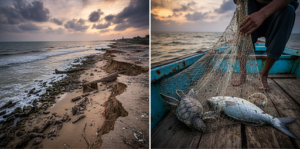
 On the moonlit beaches of Bhugra Memon and Jati, two fishing settlements in Sindh’s Badin district along the Indus Delta coast, shores once alive with the rustling of nesting turtles now lie eerily silent. A decade ago, local fishermen recall seeing dozens of Green and Olive Ridley turtles crawling ashore on a single night.
Today, the World Wide Fund for Nature (WWF) estimates that turtle nesting activity across the Badin coastal belt has declined by nearly 70 percent over the past ten to twelve years, a collapse so severe that conservationists warn these species could disappear from these shores within years, not decades. WWF’s coastal monitoring and community conservation assessments in Sindh repeatedly flag habitat loss, illegal fishing gear, and unchecked coastal development as the primary drivers behind this decline.
A week-long investigation by Sindh Climate across Badin’s severely eroded coastline reveals that the threat facing turtles is not only ecological — it is profoundly human.
Monitoring reports issued by the Sindh Wildlife Department between 2020 and 2024 show that rising sea levels and tidal surges have swallowed up to 1.6 kilometres of shoreline in several pockets of Badin. Entire turtle nesting zones now lie underwater. Guided by ancient migratory instincts, turtles return annually only to find their nesting beaches erased or replaced by encroached, debris-laden coastlines.
Further inland, saline intrusion advancing as far as 80–90 kilometres from the Arabian Sea has devastated agriculture, forcing thousands of families to abandon farming and depend almost entirely on fishing. This shift has intensified pressure on marine ecosystems. Wildlife officials recorded more than 35 turtle deaths in 2023 alone, largely due to entanglement in illegal nylon gillnets.
At Shaheed Fazil Rahu, an estuarine stretch along the delta, an 18-year-old volunteer, Aaqib, described the rapid decline. Part of a local youth group that rescues stranded hatchlings, he recalled:
“When we started three years ago, we found eight to ten nests in a single night. Now we are lucky if we find one in a week.”
He held up a crushed turtle egg, damaged by a tractor used for illegal sand lifting. His voice shook—not from fear, but helplessness.
Satellite imagery analysed by SUPARCO confirms aggressive coastal modification in Badin, including private land developments carved out less than 200 metres from the high-tide line, in violation of environmental safeguards. Conservationists say visual satellite comparisons over time clearly show shrinking beaches and fragmented nesting habitats.
Under the Sindh Wildlife Protection Act, 2020, all marine turtles are protected species, and the destruction of nesting sites, poaching, or trade in turtle parts is a punishable offence. Similarly, the Sindh Fisheries Ordinance restricts harmful fishing gear in coastal waters. Yet enforcement remains notoriously weak. Officials privately acknowledge that political pressure, limited staffing, and a shortage of patrolling boats make sustained action “almost impossible.”
During interviews, fishermen admitted that nylon gillnets — widely banned internationally for their indiscriminate killing of marine life — are still sold openly in coastal markets. In remote belts, turtle shells reportedly fetch up to Rs 10,000, fuelling clandestine poaching.
Akbar Mallah, 45, a seasoned fisherman from Jati, has spent his life navigating the Indus Delta. He remembers when turtle nests were a familiar sight rather than a desperate discovery.
“We used to guide tourists to the turtle beaches; it was a small income for us. Now the tourists don’t come because the beaches are gone. The sea is stealing the land from our village, and the salt is poisoning our wells. The turtles are the first to leave, but we are next.”
His words underscore how biodiversity loss directly translates into economic and social displacement.
In Bhugra Memon, Sain Bux, in his early sixties, once farmed cotton and chillies. Today, after salinization destroyed his land, he collects plastic debris along the shore to survive.
“The salt came first. It killed my crops. Then the sea came closer, washing away the sand where the big turtles laid their eggs. They need dry, soft sand, but now everything is wet or covered in concrete. If the sea can take the land from the turtles, it will take it from us too.”
His testimony captures the ground reality of how climate-driven saline intrusion is disrupting the turtle nesting cycle while hollowing out human livelihoods.
Muhammad Usman Mallah, 22, a student and volunteer conservationist from Jati, represents a new generation fighting to protect their ancestral coast. Leading nightly patrols, his group searches for turtle tracks and endangered nests.
“If a nest is too close to the tide, we carefully move the eggs higher up the dune. We know it’s risky, but it’s the only option. We are not scientists — we are the children of this land, trying to save what’s left. We need the law to work, we need the police to stop the poachers, and we need the government to protect this coast.”
This community-led relocation of nests — though not a substitute for institutional action — reflects local climate adaptation in the absence of state support.
The disappearance of turtles signals a collapse far greater than a single species. Marine biologists warn that turtles help maintain seagrass beds and regulate jellyfish populations. Their loss accelerates ecological imbalance, directly threatening fisheries that coastal communities depend upon.
Yet amid neglect, hope persists. At a community-run hatchery near Jati, volunteers have released over 12,000 hatchlings in the past four years, proving that when communities are empowered, conservation is possible — even on the frontlines of climate change.