
 By SADAF SULEMAN:
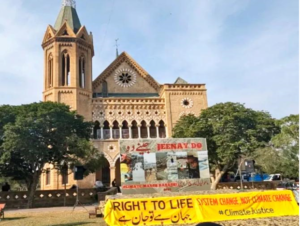
Hundreds of citizens gathered at Frere Hall on Sunday to call for urgent action on climate change, environmental degradation and urban pollution, as Karachi continues to face mounting ecological pressures.
The Climate March 2025, held from 2pm to 5.30pm at the historic gardens, brought together environmentalists, social activists, students, labourers, women and transgender persons from across the city. Participants carried placards demanding clean air, sustainable water management and climate-resilient urban planning.
The event was organised by a coalition of grassroots movements and led by Ahmad Shabbar of the Pakistan Maholiati Tahaffuz Movement, Wali Haider of Roots for Equity, and Noreen Fatima of the Women Democratic Front.
Held under the slogan “Jeeny Do” (Let Us Live), the march highlighted the growing impact of climate change on everyday life in Karachi, particularly for low-income and marginalised communities affected by air pollution, water shortages and extreme heat.
Placards carried by participants bore slogans such as “Climate justice is social justice” and “Clean air is our right,” while students and labourers chanted calls for environmental protection as a fundamental right.
Hanifa Ameer, a Social Activist, said the climate crisis had become a daily reality for residents of the city and warned that continued environmental neglect would deepen existing inequalities. She criticised ongoing deforestation and the loss of urban green spaces, calling them major contributors to rising temperatures and declining air quality.
“Climate change is no longer an abstract issue, it is visible in the form of polluted air, water scarcity and rising heat,” she said, “Deforestation, whether in the name of development or commercial interests, is accelerating these problems and putting lives at risk.”
Hanifa also pointed to gaps in environmental governance, urging authorities to move beyond commitments on paper and implement existing climate and environmental policies.
“What is missing is serious implementation of policies that protect forests, regulate emissions and centre communities in climate planning.” she said, “Environmental protection is essential for survival, not a choice.”
Several speakers addressed the march, including Wali Haider, Hafeez Baloch (Sindh Indigenous Rights Alliance), Azeem Dehkan from Malir, Saeed Baloch representing fisherfolk communities, Dr Azra of the Pakistan Kissan Mazdoor Tehreek (PKMT), and Aradhiya from the Aurat (Moorat) March. Speakers drew attention to how climate impacts intersect with issues of land rights, food security, gender inequality and livelihoods.
Participants also raised concerns over proposed plans for constructing additional canals on the Indus River (Sindhu Darya), warning that further diversion of water could exacerbate water scarcity, harm ecosystems and threaten livelihoods in downstream communities.
The programme featured a performance by Sheema Kermani, using art and movement to underscore themes of resistance, resilience and ecological balance.
Participants called on authorities to enforce stricter controls on industrial emissions, improve waste management systems and prioritise sustainable urban development. Several speakers criticised what they described as weak implementation of environmental regulations and limited public participation in climate-related decision-making.
According to global climate assessments, Pakistan is among the countries most vulnerable to climate change despite its minimal contribution to global greenhouse gas emissions.
The march continued a long tradition of civic activism at Frere Hall, a historic site often used for public expression in the city. As the event concluded, organisers said they would continue engaging with policymakers at municipal and federal levels to push for stronger environmental protections.