
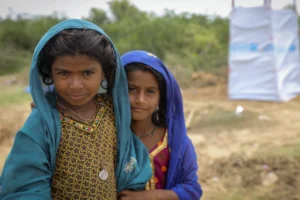
 Climate Migration in Sindh: The Journey of a Thari Hindu Mother
Before sunrise in a small desert village of Tharparkar, Meera carefully tied a cloth bundle of clothes and food. Her small mud house stood quietly behind her, surrounded by dry fields and empty wells. For generations, Meera’s Hindu family had lived in this village. They grew millet, kept goats, and celebrated festivals together under the desert sky. Life was simple, but it was theirs. But the desert had changed.
For years, the rains had become unpredictable. Some seasons brought extreme drought, while others brought sudden floods that washed away fragile mud houses. The wells dried up, crops failed, and livestock died one by one. Holding her two-year-old son Ravi in her arms, Meera stepped onto the dusty road. Her daughter Kavita, only seven years old, walked beside her barefoot. They were leaving their home.
Across Sindh, climate change is quietly forcing rural families to migrate to cities. Rising temperatures, droughts, floods, and seawater intrusion are destroying livelihoods. During the 2022 floods, nearly one-third of Pakistan was submerged and about 8 million people were displaced, many from Sindh’s poorest communities.
For minority families in remote districts like Tharparkar, the struggle is even harder. Limited access to water, healthcare, and employment means climate disasters push them into deeper poverty.Meera’s husband had already left months earlier for Karachi, hoping to find work as a daily labourer. Farming was no longer possible in their village.
The journey to Karachi took nearly eight hours on a crowded bus. Inside were many other families from Badin, Umerkot, and Dadu—each carrying their own stories of loss. When the bus entered Karachi, the city felt overwhelming. Endless traffic, tall buildings, and crowded streets replaced the quiet desert landscape Meera knew all her life.
Her husband had arranged a small space in a makeshift settlement on the city’s outskirts. Plastic sheets and bamboo sticks formed fragile shelters where thousands of climate-migrant families now live. Life in the city was not easy. Water had to be collected from distant taps. Work was uncertain. Many migrant children, including Kavita, could not attend school.
Experts estimate hundreds of thousands of Pakistanis migrate internally every year due to climate-related disasters and economic loss, and women and children bear the heaviest burden of displacement.
At night, Meera sits outside the shelter holding Ravi while Kavita looks at the glowing city lights.
“Amma,” Kavita whispers,
“Will we ever go back to our village?”
Meera closes her eyes for a moment.
She remembers the desert winds, the festivals of Diwali in Thar, and the small fields that once fed their family. Somewhere far away in the desert, clouds are forming again. But for now, like thousands of mothers from rural Sindh, Meera waits — carrying hope, memories, and the quiet pain of a home left behind.