
 Report by NAZISH ABRO
A pungent, fish-like odour spread across Karachi on Wednesday, September 16, raising concerns among residents as the city moved towards the end of the monsoon season. The smell, reported in neighbourhoods ranging from the coastline to areas farther inland, has been linked by marine experts to seasonal changes in the Arabian Sea.
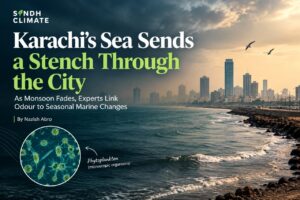
According to marine specialists, the likely source is the decomposition of phytoplankton—microscopic organisms that flourish in seawater and form a vital part of the marine food chain. Their natural growth and decline can produce noticeable changes in coastal conditions.
A seasonal shift beneath Karachi’s waters
Muhammad Moazzam Khan, technical adviser on marine resources at WWF-Pakistan, explained that monsoon conditions encourage the growth of phytoplankton in coastal waters. As the season changes, some of these organisms die and break down, releasing compounds responsible for the unpleasant smell.
Phytoplankton inhabit the sunlit upper layers of the sea, extending to approximately 100 metres below the surface, according to the expert accounts. Although microscopic, these organisms support marine ecosystems by contributing to the foundation of the ocean’s food web.
Khan also pointed to a similar occurrence in Karachi in 2024, suggesting that the recent smell is associated with a recurring seasonal process rather than an entirely new phenomenon.
From the shoreline to the city’s streets
Residents reported the odour in several parts of Karachi, including Clifton, DHA, Korangi, PECHS, Saddar, Orangi, North Nazimabad, Federal B Area, MA Jinnah Road, Tower and Kharadar.
The distribution of the smell was influenced by weather conditions. The Pakistan Meteorological Department reported weak sea breezes from Tuesday night into Wednesday morning. Reduced air movement along the coast can allow odours to linger and travel beyond areas immediately adjacent to the sea.
PMD spokesperson Anjum Nazir Zaigham and climate change expert Fatima Yamin also discussed the role of atmospheric conditions, wind circulation, smog and a low-pressure system near Jamnagar, India. These factors may have contributed to the movement of air and the persistence of the smell across the metropolis.
While experts have identified marine decomposition as the likely source, the available explanations do not establish that the odour itself resulted from toxic industrial pollution or climate change.
A reminder of Karachi’s coastal vulnerability
The incident highlights the connection between Karachi’s marine environment and the air experienced by its residents. Seasonal processes in coastal waters can become noticeable across the urban landscape when wind patterns and atmospheric conditions favour the movement of odours.
It also underlines the importance of distinguishing naturally occurring marine events from other environmental hazards. Although the reported smell has been associated with phytoplankton decomposition, Karachi continues to face wider challenges involving air quality, coastal pollution and the health of its marine ecosystems.
Understanding these interconnected pressures is essential for strengthening environmental monitoring and public awareness in a city whose identity and daily life remain closely tied to the sea.
Stronger breezes may bring relief
The Pakistan Meteorological Department reported that southwesterly sea breezes strengthened on Wednesday evening, reaching up to 22 kilometres per hour. The department expected the sea breeze to become fully active from Thursday, potentially helping disperse the odour.
Experts expected the smell to weaken as atmospheric circulation improved. Ecologist Rafiullah said there was no concrete evidence at the time establishing a specific health threat from the odour itself, although dusty air combined with the smell could potentially aggravate discomfort among people with sinusitis.
For Karachi, the episode offers an important environmental lesson: the sea is not separate from the city. Its seasonal changes, biological activity and surrounding weather systems can directly shape urban experiences. As the monsoon retreats, the unusual smell serves as a reminder of the complex ecological relationship between Karachi and its coastline.