
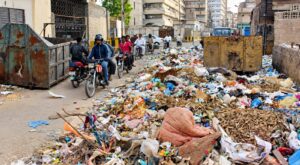
 Rs160–170bn spent on Karachi waste management over nine years, more than BRT projects, yet garbage problem persists
Former federal secretary, former caretaker provincial minister and Chairman of the Policy Research & Advisory Council (PRAC) Mohammad Younus Dagha has said that an estimated Rs160–170 billion has been spent on garbage collection and waste management in Karachi since 2017, yet the city continues to face serious cleanliness and waste disposal problems.
Dagha said overall spending on garbage collection and street sweeping across Sindh has exceeded Rs190 billion since 2017, including the current year’s allocation, while the estimated spending on Karachi alone stands at Rs160–170 billion.
He said the amount spent on Karachi’s waste management was higher than the provincial financing received by several major initiatives during the past decade, including the BRT Red Line, BRT Yellow Line, K-IV water supply project, Safe City project, Karachi’s road network and the Right Bank Outfall Drain.
Dagha said that despite the substantial expenditure, garbage disposal remains one of Karachi’s major problems. He pointed out that open plots continue to be used as informal dumping grounds, while door-to-door garbage collection remains patchy or completely absent in many localities. He added that waste also continues to accumulate along roads, open spaces and drains.
He said the waste-management system includes door-to-door collection, street sweeping, transportation of waste to transfer stations and landfill sites, provision of bins and compactors, deployment of sanitary workers and GPS-based monitoring.
Dagha further said that third-party verification of waste contractors’ performance has not been carried out since 2017. He said reports of the Auditor General of Pakistan from 2018 to 2025 had repeatedly highlighted issues including payments made without third-party verification, uncollected penalties, inadequate staffing and overpayments.