
 Report by NAZISH ABRO
BADIN / THATTA, SINDH — Long before the midsummer sun bleaches the salt-encrusted plains of Lower Sindh, Bachai is already awake.
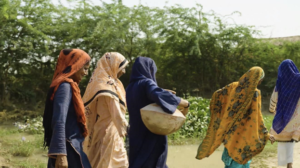
At 4:30 a.m., inside a modest mud-and-thatch dwelling on the outskirts of Badin district, she secures two empty 15-litre plastic containers with frayed nylon rope. The silence of dawn offers little comfort; it simply signals the beginning of another exhausting three-kilometre journey across parched, cracked earth towards a brackish tube well.
“Every morning begins with a knot in the stomach,” says Bachai, a 38-year-old mother of four. Her hands, calloused from years of domestic labour and water collection, tighten around the handles of the containers. “If the tube well runs dry, or if the water turns yellow and bitter, the entire household collapses. We have lived through the super floods and scorching heatwaves, but the real disease is in the mind. It is the fear that never goes away.”
For women like Bachai, climate change is not simply an environmental concern discussed at international conferences. It is an everyday struggle for survival, accompanied by uncertainty, exhaustion, anxiety and the persistent fear of what tomorrow might bring.
Beyond Physical Destruction: The Invisible Cost of Climate Disasters
When climate disasters strike Pakistan’s southern province of Sindh, attention often centres on visible destruction: breached embankments, submerged agricultural land, damaged infrastructure, destroyed homes and the enormous financial costs of reconstruction.
Yet, beyond the physical devastation lies another crisis that receives considerably less attention: the psychological consequences of repeated climate disasters, particularly for rural women.
In agricultural districts such as Badin and Thatta, recurring environmental shocks—including extreme heatwaves, floods, sea intrusion, water scarcity and groundwater salinisation—have intensified the everyday responsibilities of women.
In many rural households, women are responsible for securing drinking water, managing limited food supplies, caring for children and elderly family members, and maintaining household stability despite increasingly difficult living conditions.
When agricultural livelihoods collapse, livestock perish and household incomes disappear, women frequently become responsible for managing the consequences. In some communities, men migrate to urban centres in search of employment, leaving women to navigate household responsibilities, food insecurity and emotional distress with limited support.
The result is a growing but largely overlooked mental health burden.
The Anatomy of Climate Anxiety
The psychological consequences of climate change extend far beyond the immediate experience of a disaster. Repeated exposure to floods, droughts, extreme temperatures and displacement can contribute to anxiety, depression, post-traumatic stress disorder (PTSD) and eco-anxiety.
For women who have experienced repeated displacement or the destruction of their livelihoods, even the arrival of the monsoon can trigger memories of previous disasters.
“When dark clouds gather before the monsoon, women don’t see rain; they see displacement,” explains a Lady Health Worker serving a rural community near Badin’s coastline. Previous experiences of losing homes, giving birth in makeshift shelters and struggling to access medical assistance can leave lasting psychological scars.
Nasir Ali Panhwar, an Environment and Climate Change Expert, highlights the disproportionate psychological burden experienced by economically disadvantaged communities, particularly rural women and children.
“The mental health impacts of climate change include anxiety, depression, Post-Traumatic Stress Disorder (PTSD) and eco-anxiety. These effects are documented, particularly among economically disadvantaged groups. In rural areas, the impact is especially noticeable among women and children. Rural women often handle household survival alone when men migrate for work. This situation creates significant psychological stress.”
He further explains that farming communities, low-income families and indigenous groups experience overlapping challenges, including environmental stress, food scarcity, malnutrition and limited access to healthcare. These pressures collectively weaken their mental resilience.
“In areas severely impacted like Kohistan Thar and Nara region, rising temperatures and droughts have also been linked to higher rates of aggression, domestic violence, and suicide.”
Panhwar emphasises that the increasing prevalence of anxiety, depression and stress makes targeted mental health support and integrated climate adaptation strategies essential.
His observations highlight an important reality: climate resilience cannot be measured solely through rebuilt infrastructure or restored agricultural production. It must also account for the psychological well-being of the people expected to recover from these disasters.
When Climate Disasters Deepen Gender Inequality
The psychological toll of climate change is closely connected to existing gender inequalities.
In many rural communities, women have limited control over household finances, restricted mobility and inadequate access to healthcare. When a climate disaster strikes, these structural inequalities become even more pronounced.
Financial insecurity, crop failures and the loss of livestock can intensify household tensions and domestic conflict. Women are often expected to maintain family stability despite having little control over the economic and environmental circumstances affecting their households.
Cultural stigma further complicates the situation. Expressing fear, emotional exhaustion or psychological distress may be interpreted as weakness rather than recognised as a legitimate response to prolonged hardship.
For many women, suffering therefore remains invisible.
Access to professional mental healthcare is another major challenge. Psychiatric services are concentrated in larger urban centres such as Karachi and Hyderabad, while rural Basic Health Units (BHUs) and Rural Health Centres (RHCs) often lack trained professionals and adequate resources to identify and address mental health conditions.
As a result, women experiencing psychological distress may never receive appropriate assessment or support.
Climate Justice Begins with Protecting Women’s Dignity
The mental health crisis is only one dimension of the wider vulnerability experienced by rural women during climate emergencies. Their reproductive health, menstrual hygiene, maternal care and access to essential services are also frequently overlooked.
Humaira, Sindh President of Climate Forward Pakistan, recalls witnessing this neglect during the 2022 super floods in Pakistan.
“During the 2022 super floods in Pakistan, I witnessed how women’s basic needs were overlooked in emergency relief efforts. While people were collecting food, ration bags and mosquito nets, I saw women in the riverine communities sitting in soaking-wet clothes, having lost their belongings and livestock to the floodwaters. What struck me most was that many of these women were pregnant, while others had no access to basic menstrual hygiene products. Their dignity and essential needs were not receiving the attention they deserved.”
That experience became a turning point in her journey towards climate justice. She initiated her first relief effort in Sujawal, near Thatta, distributing sanitary pads, underwear, biscuits and black chickpeas to women whose needs had been overlooked in emergency response efforts.
Her experiences during subsequent disasters reinforced the same concern.
“In the 2025 floods in Southern Punjab, I witnessed the same vulnerability again. I remember a nine-month pregnant woman who had already passed her expected delivery date by ten days and was stranded amid floodwaters. Her family could not afford to arrange transportation to a nearby hospital. With no ambulance available, I arranged a private vehicle to take her for medical assistance.”
Reflecting on these experiences, Humaira emphasises that rural women remain among the most neglected during climate emergencies.
“Even when they are on the verge of giving birth, their most basic needs and access to emergency healthcare can remain unmet. Climate justice must also mean protecting women’s dignity, health, livelihoods and access to essential services during disasters.”
Her account illustrates why disaster response must move beyond the distribution of food packages and temporary shelter. Women’s reproductive health, menstrual hygiene, maternal healthcare, psychological well-being and personal dignity must be treated as essential components of emergency relief.
Breaking the Silence: Mental Healthcare at the Grassroots
Despite the scale of the challenge, there are practical approaches that could help address the psychological consequences of climate change in vulnerable communities.
One promising approach is task-sharing, a model supported by the World Health Organization’s Mental Health Gap Action Programme (mhGAP). It involves training frontline healthcare workers and community-based personnel to identify common mental health conditions, provide basic psychosocial support and refer individuals requiring specialised treatment.
In rural Sindh, Lady Health Workers could play a particularly important role.
Because they already interact with women through maternal healthcare, immunisation and community health programmes, integrating basic mental health screening into their routine responsibilities could help identify psychological distress at an earlier stage.
Community-based support groups could also provide safe spaces where women can discuss their experiences without fear of judgement or discrimination.
Partnerships involving healthcare institutions, local organisations, psychologists and climate-focused civil society groups could further strengthen these efforts.
Importantly, mental health interventions should not operate independently of climate adaptation programmes. Women experiencing repeated displacement, water insecurity, food shortages and livelihood losses need both psychological support and practical solutions to the environmental challenges affecting their lives.
Rethinking Climate Resilience: Putting People at the Centre
As Pakistan continues to strengthen its climate adaptation policies and disaster management frameworks, the psychological dimensions of climate change deserve greater attention.
Provincial authorities, humanitarian organisations and development partners must recognise that recovery does not end when floodwaters recede or damaged infrastructure is rebuilt.
Climate adaptation strategies should incorporate accessible mental healthcare, maternal and reproductive health services, gender-sensitive disaster preparedness, livelihood protection and community-based psychosocial support.
Investment in rural healthcare facilities, training for frontline health workers and the inclusion of women’s voices in local climate planning are equally important.
There is also a need for more research documenting the relationship between recurring climate hazards and mental health outcomes among rural populations, particularly women and children in vulnerable districts of Sindh.
Without reliable data and gender-disaggregated assessments, the psychological consequences of climate change will continue to remain outside mainstream policy discussions.
Back in her village, Bachai places the heavy water containers outside her front door. The morning heat is already rising, radiating from the cracked earth.
“Everyone comes to take pictures of broken houses and drowned fields,” she says softly, adjusting her dupatta. “No one looks inside our chests to see what has drowned in there. If our minds break, everything breaks.”
Her words capture a reality that climate statistics and disaster assessments often fail to measure.
For rural women in Sindh, the climate crisis is not just about rising temperatures, disappearing farmland or devastating floods. It is also about the fear of losing their homes, the anxiety of feeding their children, the uncertainty of accessing healthcare and the emotional exhaustion of rebuilding their lives after every disaster.
The floodwaters may eventually recede, but the psychological consequences can remain long after the physical destruction has disappeared.
Recognising this invisible crisis is not simply a matter of improving healthcare. It is a question of gender equality, human dignity and climate justice.
Because climate resilience is not possible if the people carrying the greatest burden of survival are left to suffer in silence.