
 BY NAZISH ABRO
At a time when Pakistan is grappling with soaring fuel import costs, a widening energy deficit, and mounting pressure on its foreign exchange reserves, a fresh oil and gas discovery in Sindh has delivered a welcome dose of optimism.
The Oil and Gas Development Company Limited (OGDCL) has announced a significant hydrocarbon discovery at the Bobi Deep-1 exploratory well in Sanghar district—another reminder that Sindh remains the beating heart of Pakistan’s energy sector.
While the discovery alone will not transform Pakistan into an oil-rich nation overnight, it represents another meaningful step towards strengthening domestic energy production and reducing reliance on imported fuels.
A New Energy Success Beneath Sindh’s Soil
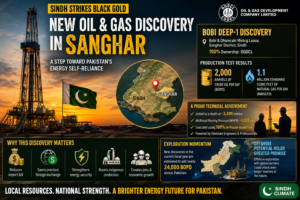
Located within the Bobi and Dhamraki Mining Lease, where OGDCL holds 100 percent ownership, the Bobi Deep-1 well has produced encouraging results following extensive drilling, geological studies and production testing.
Initial testing indicates the well can produce approximately:
- 2,000 barrels of crude oil per day (BOPD)
- 1.1 million standard cubic feet of natural gas per day (MMSCFD)
These production levels are considered commercially viable and will contribute to Pakistan’s indigenous hydrocarbon supply once brought into regular production.
For a country that spends billions of dollars annually importing crude oil, refined petroleum products and liquefied natural gas (LNG), every new barrel produced domestically translates into reduced pressure on national finances.
A Victory for Pakistani Engineers
Beyond the hydrocarbons themselves, the discovery showcases Pakistan’s growing technical capabilities.
The Bobi Deep-1 well was drilled to nearly 3,300 metres using OGDCL’s own engineering expertise and operational resources. According to the company, the project was completed without foreign technical assistance, reflecting the increasing competence of Pakistan’s petroleum professionals.
During production testing, engineers recorded a Wellhead Flowing Pressure (WHFP) of around 1,005 psi, indicating a healthy reservoir with sufficient natural pressure to support efficient hydrocarbon production.
The achievement demonstrates that Pakistani engineers continue to develop sophisticated exploration and drilling expertise capable of unlocking complex underground resources.
Why Every Barrel Matters
Pakistan imports a substantial portion of its energy requirements every year, making international oil price fluctuations a constant threat to economic stability.
Although 2,000 barrels of oil per day represent only a small percentage of Pakistan’s overall demand, discoveries like Bobi Deep-1 have cumulative national importance.
Each successful well helps to:
- reduce Pakistan’s costly fuel import bill;
- conserve precious foreign exchange reserves;
- strengthen national energy security;
- improve indigenous oil and gas production;
- create employment and economic activity in exploration areas; and
- encourage further investment in Pakistan’s upstream petroleum sector.
Energy experts often point out that long-term energy security is built not through one giant discovery alone but through a steady stream of commercially successful exploration projects.
Sindh Continues to Drive Pakistan’s Energy Sector
The latest discovery further reinforces Sindh’s status as Pakistan’s energy powerhouse.
For decades, the province has supplied much of the country’s natural gas and crude oil while also hosting major coal reserves in Thar, one of the world’s largest wind corridors between Gharo and Jhimpir, expanding solar energy projects, and rapidly growing industrial energy infrastructure.
From conventional hydrocarbons to renewable energy, Sindh has become central to Pakistan’s strategy for meeting rising energy demand.
The Sanghar discovery adds another chapter to this long history, highlighting the province’s strategic importance in ensuring a reliable domestic energy supply.
Exploration Momentum Continues
Industry observers note that Pakistan’s exploration sector has shown encouraging momentum during the current fiscal year.
Recent discoveries across the country are estimated to add nearly 24,000 barrels of crude oil per day, with many successful exploration efforts concentrated in Sindh and the Potohar region.
These findings suggest that Pakistan’s sedimentary basins continue to hold commercially viable hydrocarbon resources waiting to be developed.
Continued exploration, supported by modern seismic technologies and improved geological analysis, could unlock even greater reserves in the years ahead.
Offshore Exploration Could Be the Next Frontier
While onshore discoveries continue to strengthen domestic production, many energy specialists believe Pakistan’s biggest breakthrough may still lie offshore.
Exploration in offshore basins, undertaken with international partners, has the potential to uncover significantly larger reserves of oil and natural gas.
If commercially viable offshore deposits are confirmed, they could dramatically reshape Pakistan’s energy landscape, reducing dependence on imported fuels and improving long-term energy resilience.
Until then, discoveries like Bobi Deep-1 remain essential building blocks in Pakistan’s journey toward greater energy independence.
Looking Ahead
The Bobi Deep-1 discovery is far more than another successful drilling operation. It reflects Pakistan’s growing exploration expertise, the dedication of local engineers, and the untapped resource potential that continues to lie beneath Sindh’s landscape.
No single well can solve Pakistan’s energy challenges. However, every successful discovery strengthens the country’s foundation for a more secure, affordable and self-reliant energy future.
As exploration continues across Sindh and other prospective basins, each new discovery brings Pakistan one step closer to reducing its dependence on imported fuel, strengthening its economy and ensuring that more of the nation’s energy needs are met from resources beneath its own soil.
For Sindh, the message is clear: the province remains not only Pakistan’s energy heartland but also one of its greatest hopes for a stronger and more sustainable energy future.